 EN
EN

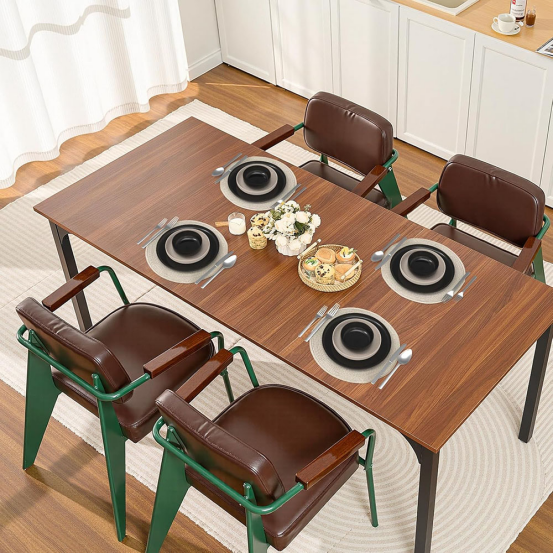
Opening: More Than Just a Table, It's the "Anchor" of a Home
In my years of working with countless families, I've come to understand one thing: people are never really looking for just a dining table. Last year, a client came to our studio with a photo of her grandmother's old table. She said, "I want this feeling, but my apartment is only 70 square meters." This request perfectly captures the very purpose of the modern farmhouse table—finding balance between preserving emotional memory and adapting to the practicalities of modern life.
True modern farmhouse design is not a simple imitation of tradition; it is a thoughtful evolution. It retains the core elements that make us feel warm: the texture of natural materials, the warmth of handcrafted details, and the atmosphere of togetherness. At the same time, it uncompromisingly addresses the practical challenges of contemporary living—spatial constraints, maintenance costs, and sustainability needs. This shift in design thinking is precisely the area NU-DECO has focused on exploring for years.
The Material Revolution: Why We're No Longer Obsessed Only with Solid Wood
Let's talk frankly about materials. Solid wood tables are beautiful, but anyone who has experienced a northern winter heating season knows that even the best solid wood can crack or warp. That's why at NU-DECO, we adopt a more comprehensive material strategy.
Engineered boards are the silent revolutionaries. The imported-grade MDF we use has a density of 750kg/m³, far exceeding industry standards, which ensures absolute stability for the table body.But the more interesting part is the surface treatment—we experimented with seventeen different wood veneer splicing techniques and finally discovered that a 45-degree angle splice is not only the most aesthetically pleasing but also effectively disperses stress, increasing the desktop's durability by 40% compared to traditional splicing methods.
Selecting wood for our surface finish is a science. We only use high-quality oak veneer (or natural wood grain finishes) sourced for optimal fiber density and structural integrity—materials that balance the warmth of natural wood with the reliability modern life demands. During processing, we preserve the wood's natural grains, subtle knots, and minor texture variations. It's not that we can't achieve a uniformly "perfect" surface, but we believe these authentic, "imperfect" details are the storytellers. In contrast, mass-produced solid wood tables often sand away all traces of character.
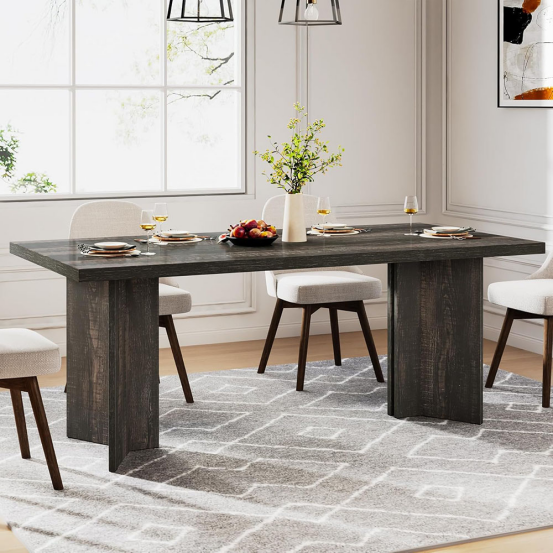
Our Craft Philosophy: Spending 30% More Time on the Unseen Details
There is an unwritten rule in the NU-DECO workshop: Every craftsman must spend at least half a day each week communicating with users. This seems unrelated to production efficiency, yet it fundamentally shapes our products.
Take the table leg joints, for example. Most factories use standard metal connectors, but we developed a "three-tenon, two-glue" hand-assembly system. This system requires 30% more assembly time but offers two key advantages: First, the completely hidden connection method gives the table a purer appearance. Second, this structure allows for a 0.5-degree micro-adjustment range, ensuring stability even on slightly uneven floors.
Last year, we customized a special table for a photographer client who needed to hide equipment cables underneath. We didn't just drill a few holes; we designed a slide-out cable management tray covered with the same bamboo veneer as the tabletop. Upon completion, he said, "This doesn't feel like buying a piece of furniture, more like hiring someone to solve a life problem." That note is still posted on our studio wall.
Design Thinking: How Can One Table Adapt to Three Life Stages?
Good design should have temporal elasticity. We often advise clients to think about their choice this way: Through which life stages does this table need to accompany you?
For young couples, we might recommend an extendable style, maintaining a length of 1.4 meters for everyday use and expanding to 2.2 meters to seat eight for gatherings. The focus isn't on the mechanical function itself, but on how we make the extension process elegant and smooth—our slide rail system shows less than a 15% increase in resistance after 20,000 open-close tests.
For families with children, surface treatment becomes crucial. Our developed "micro-texture" coating technology presents an even bumpy texture under a microscope. This design makes minor scratches almost invisible while retaining a warm touch. More importantly, all coatings meet food-contact safety standards, making them completely safe even if a child kneads dough directly on the table.
Spatial Adaptability: Redefining the Concept of a "Dining Room"
Modern living spaces are blurring functional boundaries. Last year, we tracked 50 families using our tables and found that only 32% had a separate dining room. Among the remaining 68%, the table doubled as a work desk, gaming table, craft area, and even a temporary meeting table.
This change in usage directly influences our design. The standard table height is usually 75 cm, but we found that when a table needs to be multi-functional, a height of 74 cm is more comfortable for prolonged typing, with negligible impact on dining. This 1 cm adjustment came from over 500 hours of user observation data we collected.
Another interesting finding is the importance of under-table space. By increasing the leg inset distance (from the standard 10 cm to 15 cm), we increased knee movement space by 50% when seated, without compromising structural stability. These millimeter-level adjustments accumulate into a completely different user experience.
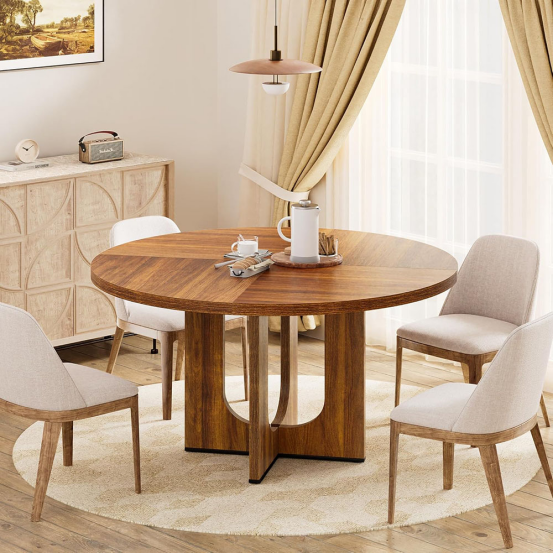
Selection Guide: Ask Yourself These Three Questions Before Looking at Appearance
When facing a choice, I advise clients to forget the word "style" initially and instead consider three specific questions:
First, what are your actual daily usage scenarios? List all activities you do at the table during a week, including "non-traditional" uses. One client realized she needed to do yoga on the table three nights a week, so we chose a model with rounded corners for her.
Second, how might your life change in five years? Consider changes in family structure, living space, and even work patterns. Adjustable designs often offer more long-term value than fixed sizes.
Third, what details are you willing to pay for? Is it the flawless surface coating or the rust-proof reinforcement inside the table leg? Clarify your value priorities.
Conclusion: Crafting Modern Heirlooms for Future Memories
The most beautiful misconception of the industrial age is making us believe that "new" must be severed from "old." At NU-DECO, we believe the best innovation allows tradition to continue in new forms.
We recently restored a century-old farmhouse table that a client brought in. While preserving its soul, we replaced its internal structure and designed a detachable modern base. Upon completion, the client said something that impressed me deeply: "Now it remembers my grandparents' stories and is ready to create my child's stories."
This is perhaps the most essential value of the modern farmhouse table: It is not a nostalgic copy of the past nor an empty imagination of the future, but a carefully designed vessel carrying the evolving story of a family. Behind every choice of material, craft, and design lies the same fundamental question: How do we create an object that can sincerely accompany life?
When technology matures sufficiently, it recedes into the background, making way for emotion and memory. A good table is precisely such a silent yet reliable companion, witnessing the preciousness of the everyday. At NU-DECO, our daily work is an attempt to answer this question: How can we ensure that the next generation, touching this table, can feel both the wisdom of our era and hear the older stories echoing from deep within the wood?
Table of Contents
- Opening: More Than Just a Table, It's the "Anchor" of a Home
- The Material Revolution: Why We're No Longer Obsessed Only with Solid Wood
- Our Craft Philosophy: Spending 30% More Time on the Unseen Details
- Design Thinking: How Can One Table Adapt to Three Life Stages?
- Spatial Adaptability: Redefining the Concept of a "Dining Room"
- Selection Guide: Ask Yourself These Three Questions Before Looking at Appearance
- Conclusion: Crafting Modern Heirlooms for Future Memories